

Healthcare software development sits at the intersection of execution precision and regulatory compliance. As medical technologies evolve, backend systems process sensitive patient telemetry, secure electronic health records (EHR), and process real-time medical device signals. Achieving rapid performance while adhering to regulations like the Health Insurance Portability and Accountability Act (HIPAA) presents an engineering challenge.
Adopting specialized Rust software development Princeton NJ practices provides healthcare institutions and biotech firms with the speed and safety necessary to scale digital health infrastructure. Modernizing healthcare platforms through dedicated Secure software development Princeton NJ principles ensures sensitive telemetry and EHR streams remain fully protected at the machine level.
Traditional programming languages force engineering teams to make trade-offs. Higher-level languages offer memory safety at the cost of execution speed and predictable latency. Lower-level languages deliver raw performance but introduce severe security risks through memory vulnerabilities. Memory corruption flaws, such as buffer overflows and use-after-free bugs, remain leading causes of security breaches in software platforms. Partnering with engineering teams providing elite Rust development services Princeton NJ organizations trust bridges this gap completely.
Rust eliminates this trade-off completely. Designed to guarantee memory safety without relying on a runtime garbage collector, Rust provides the control of legacy systems languages with modern safety guarantees. For healthcare leaders, MedTech startups, and software architects, adopting Rust offers a direct pathway to scalable, secure, and compliant digital health platforms.
MedTech Security and HIPAA Compliance
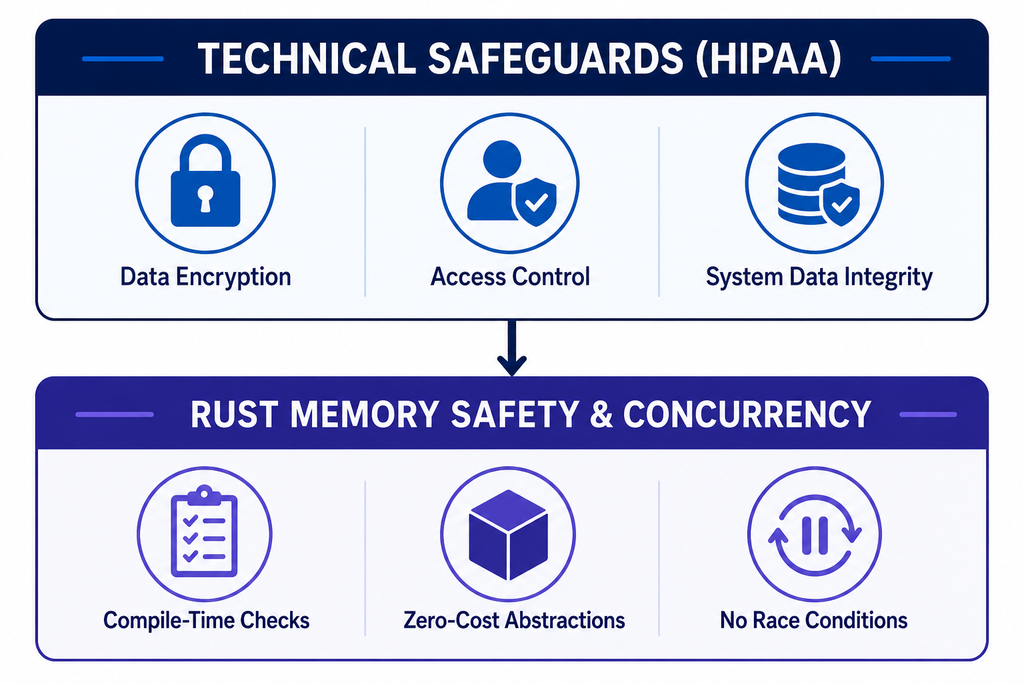
HIPAA regulations demand administrative, physical, and technical controls for Protected Health Information (PHI). Technical requirements call for data encryption at rest and in transit, strict access controls, audit logging, and system data integrity.
Building systems that comply with these technical requirements goes beyond implementing cryptographic libraries. Compliance starts at the code execution level. A software platform cannot be considered compliant if system memory vulnerabilities allow attackers to bypass authentication layers or extract raw encryption keys.
Preventing Vulnerabilities at Compile Time
Rust addresses system safety through its unique ownership model and type system. The Rust compiler enforces rules regarding how memory is allocated, borrowed, and freed. Code containing race conditions or unsafe memory pointers will not compile.
By preventing memory errors before code hits production, engineering teams eliminate up to 70 percent of potential security vulnerabilities. This structural prevention protects PHI processing pipelines from unauthorized memory access and memory-leak exploits.
Technical Benefits of Rust in Medical Systems
MedTech environments span resource-constrained Internet of Medical Things (IoMT) devices and enterprise cloud architectures. Rust delivers core structural advantages across every tier of this architecture.
- Predictable Performance for Real-Time Medical Devices: Medical wearables, patient monitors, and diagnostic tools require deterministic execution. Traditional languages rely on garbage collection cycles to manage memory, which introduces random micro-pauses in processing. In time-sensitive healthcare environments, processing delays compromise real-time telemetry tracking. Rust operates without a garbage collector, keeping response times consistent.
- Native Memory Safety for Cloud Data Pipelines: Health platforms process petabytes of unstructured medical imagery, genomic sequences, and streaming EHR updates. Rust processes high-throughput data pipelines efficiently while keeping total memory usage low. Its compile-time guarantees keep dynamic data streams isolated without risking cross-thread memory corruption.
- Reduced Hosting Costs: Resource efficiency translates into operational savings. Rust applications consume significantly less CPU power and memory compared to alternatives like Java or Node.js. For cloud-hosted HIPAA environments, lowered resource consumption allows organizations to shrink their cloud server footprint without sacrificing system performance.
Architectural Strategies for HIPAA-Compliant Rust Systems
Integrating Rust within a HIPAA-compliant ecosystem requires deliberate architecture choices. Core engineering practices maintain compliance across the software lifecycle.
End-to-End Cryptography and Safe Abstractions
Encrypting PHI at rest and in transit is mandatory. Rust features libraries for cryptographic operations. By wrapping low-level cryptographic routines in safe abstractions, developers confirm that sensitive keys clear from memory immediately after use, removing accidental exposure risks.
Microservices Isolation and Secure API Gateways
Modern healthcare architectures rely heavily on API integration across hospitals, insurance providers, and third-party tools. Rust powers fast, secure web APIs and microservices. Building API gateways in Rust maintains high throughput while applying strict input validation. Corrupted or malicious requests drop before reaching internal PHI databases.
Continuous Auditing and Verification
HIPAA compliance requires verifiable audit trails. Rust’s strict type system helps enforce authorization checks at every function boundary. Compile-time typing prevents developers from leaking unencrypted PHI into logging pipelines. Automated integration testing confirms that compliance rules remain intact as the codebase grows.
FAQs
Is Rust officially certified for HIPAA compliance?
HIPAA compliance applies to complete system architecture, operational policies, and administrative security practices, not to a programming language. Rust provides the memory safety, cryptographic support, and system stability required to build compliant software ecosystems.
How does Rust compare to C++ for medical device software?
While C++ delivers high execution speed, it requires developers to handle memory allocation manually, which introduces human error. Rust provides comparable execution speed while enforcing compile-time checks that remove memory vulnerabilities.
Can Rust integrate with existing healthcare systems and legacy stacks?
Yes. Rust features interoperability through its C Foreign Function Interface (FFI). Engineering teams can introduce Rust into existing legacy stacks to replace vulnerable modules or performance bottlenecks without rewriting the entire platform.
What makes Rust effective for IoMT (Internet of Medical Things) devices?
Rust runs directly on bare metal without requiring heavy runtimes or garbage collectors. Its small binary footprint and low resource usage fit embedded processors in medical wearables and bedside devices.
Does using Rust speed up the software regulatory audit process?
Yes. Because the Rust compiler removes common memory flaws automatically, engineering teams spend less time remediating static code analysis issues during audits. The resulting codebase remains clear, easy to inspect, and simple to document.
Modernizing Health Tech Stacks with Rust
Building compliant software for healthcare requires domain awareness and systems-level engineering practices. Transitioning core data pipelines or embedded device logic to Rust eliminates memory vulnerability classes at compile time while lowering cloud operational overhead. Review your current architecture for memory-bound performance bottlenecks and isolate candidate microservices for a Rust-based pilot implementation.
CAT Software Services Inc. builds custom software systems and modernizes legacy infrastructure for healthcare and MedTech platforms. If you are looking to scale your engineering capability, partner with experienced leaders providing Rust development services Princeton NJ organizations trust to assess processing bottlenecks, design high-throughput data platforms, and execute microservice migrations. Schedule a discovery call with our technical team today.
