
Princeton, New Jersey, hosts an active tech corridor focused on Financial Technology (FinTech) and Healthcare Technology (HealthTech). Enterprise teams and scaling startups across Princeton face demands for systems that process millions of concurrent transactions with low latency.
Leveraging specialized Golang API development services Princeton NJ technology teams provide allows local and national enterprises to engineer custom, resilient backends tailored to stringent industry demands. Whether upgrading legacy components or building high-speed data pipelines from scratch, partnering with experienced providers of Golang development services Princeton NJ organizations trust ensures seamless execution and regulatory compliance.
Processing real-time stock trades, managing payment clearing networks, and streaming live patient biometrics all require high system availability. Bottlenecks directly hurt revenue and patient outcomes. To meet regulatory standards and process large data spikes, software engineering teams choose Go (Golang) as their core backend technology for modern Golang API development.
The High-Throughput Imperative in Princeton’s Tech Ecosystem
FinTech and HealthTech platforms operate under demanding conditions where traditional monolithic architectures falter. A minor spike in latency during a high-frequency trading window or an API timeout on an electronic health record (EHR) query disrupts operations and breaches compliance frameworks.
High-Concurrency Architecture in Golang
To maintain system stability under extreme load, modern Go architectures split execution across three distinct processing layers:
- Ingress Routing Layer: An API Gateway and Load Balancer acts as the primary entry point, directing incoming traffic and distributing load across backend services.
- Concurrent Worker Layer: Independent Go worker services execute specialized tasks using lightweight goroutines. Dedicated workers manage payment processing, stream electronic health records (EHR), and run real-time fraud risk engines.
- Storage and Persistence Layer: A distributed data layer stores processed results in encrypted storage systems to satisfy compliance rules.
Modern digital platforms demand engineering frameworks that process heavy execution loads without inflating cloud hardware expenses.
Microsecond Latency Requirements
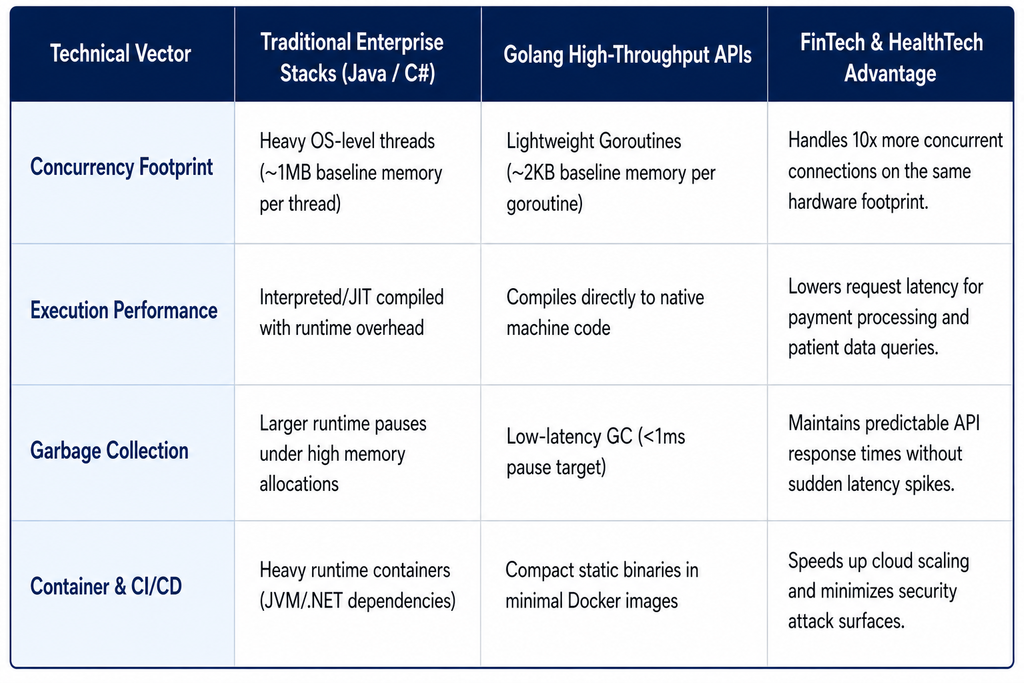
In modern payment processing and automated trading, every millisecond counts. High API response latency causes dropped transaction flows and lower conversion rates. Golang compiles directly into native machine code, bypassing virtual machine layers and enabling execution response times measured in single-digit milliseconds.
Extreme Concurrency Demands
HealthTech platforms ingest continuous streams of data from connected medical devices, wearable sensors, and real-time patient portals. Golang manages these high-throughput workloads through goroutines, which are lightweight threads managed directly by the Go runtime rather than the host operating system.
Why Golang Outperforms Traditional Stacks for Regulatory Workloads
For years, enterprise technology teams relied on traditional object-oriented platforms like Java and C#. While these ecosystems remain established, their runtime models require significant memory footprints and complex multi-threading configurations that complicate high-throughput scaling.
Engineering Compliant & Scalable Go APIs for Sensitive Industries
Building high-performance software for FinTech and HealthTech requires strict security controls. High speed cannot come at the expense of regulatory compliance, data privacy, or transaction safety.
1. Enforcing HIPAA and PCI-DSS Security Standards
Applications in Princeton’s life sciences and financial sectors must satisfy regulatory mandates, including HIPAA for patient privacy and PCI-DSS for payment operations. Go simplifies security integration across the API lifecycle:
- Strong Native Encryption: Go’s standard library (
crypto/tls,crypto/aes) provides cryptographic primitives out of the box, enforcing end-to-end encryption for sensitive data payloads in transit and at rest. - Minimal External Dependencies: Go’s standard library reduces reliance on third-party packages, reducing supply-chain vulnerabilities and simplifying security audits.
2. High-Frequency Data Streaming with gRPC and Protocol Buffers
While RESTful JSON APIs are common, high-throughput systems often require binary serialization formats. Implementing gRPC with Protocol Buffers in Go provides a compact communication layer for microservices.
- RESTful JSON Payload Format: Traditional REST APIs transmit verbose, text-heavy JSON structures containing explicit string keys (e.g.,
patient_id,heart_rate,timestamp). This approach creates large payloads that demand extra network bandwidth and CPU parsing overhead. - Protobuf and gRPC Binary Serialization: Protocol Buffers serialize data directly into compact binary byte streams. Converting JSON to Protobuf reduces payload sizes by up to 80%, cuts CPU processing overhead, and supports bidirectional streaming for live patient monitoring and instant stock quote feeds.
3. Graceful Rate Limiting and Circuit Breaking
To protect backend services from denial-of-service disruptions, sudden traffic spikes, or upstream third-party service outages, Go APIs implement resilience controls:
- Token Bucket Rate Limiting: Manages incoming request volumes per API client key, preventing resource exhaustion.
- Circuit Breakers: Isolates failing downstream services automatically, preventing cascading failures across the network.
Practical Architectural Best Practices for Go APIs
Designing enterprise-grade Go services requires structured software design patterns that simplify ongoing maintenance and testing.
- Adopt Clean Architecture: Keep business logic isolated from external transport adapters, databases, and third-party frameworks.
- Enforce Structured Context Propagation: Use Go’s
context.Contextpackage to propagate cancellation signals, request timeouts, and trace IDs across distributed API boundaries. - Implement Distributed Tracing: Integrate OpenTelemetry, Prometheus, and structured logging tools to maintain visibility into microservice latency and operational health.
FAQs
Why is Golang preferred over Node.js or Python for high-throughput FinTech APIs?
Node.js and Python use single-threaded or interpreted runtime models that struggle under CPU-intensive cryptographic or analytical workloads. Go compiles directly to native machine code and features built-in concurrent execution, delivering higher request throughput and lower latency.
How does Golang support HIPAA compliance in HealthTech applications?
Go supports HIPAA compliance by offering built-in cryptographic libraries for encrypting Protected Health Information (PHI) in transit and at rest. Furthermore, Go’s minimal dependency ecosystem makes auditing codebases and passing security compliance checks straightforward.
Can Golang integrate smoothly with existing enterprise Java or .NET backends?
Yes. Go microservices integrate with existing enterprise backends using standard RESTful HTTP, gRPC, or message brokers like Kafka and RabbitMQ. This allows engineering teams to modernize high-demand endpoints incrementally without replacing their entire legacy platform.
What performance gains can an organization expect when migrating APIs to Golang?
Companies migrating legacy APIs to Go often see 50% to 80% reductions in cloud server resource usage, along with lower latency. Go’s efficient memory management allows systems to process high request volumes on smaller, lower-cost cloud instances.
How long does it take to develop a production-ready Go API for financial transactions?
Development timelines depend on system complexity, third-party integrations, and testing scope. Using modular domain-driven design, a production-ready, compliant Go microservice can typically be architected, tested, and released in 8 to 12 weeks.
Building High-Performance Systems with CAT Software Services Inc
Building high-throughput, compliant API platforms requires technical expertise and clear engineering methodologies. Located in Princeton, New Jersey, CAT Software Services Inc assists technology organizations in building custom software solutions, modernizing legacy backend systems, and executing cloud transitions.
Our software engineering teams bring direct experience across custom Golang API development, microservices, automated testing, and regulatory software engineering. We build system architectures designed for high speed, data safety, and operational resilience across FinTech and HealthTech implementations.
To address your technical architecture and backend performance goals with industry-leading specialists in Golang API development services Princeton NJ firms rely on, reach out directly to CAT Software Services Inc today.
