
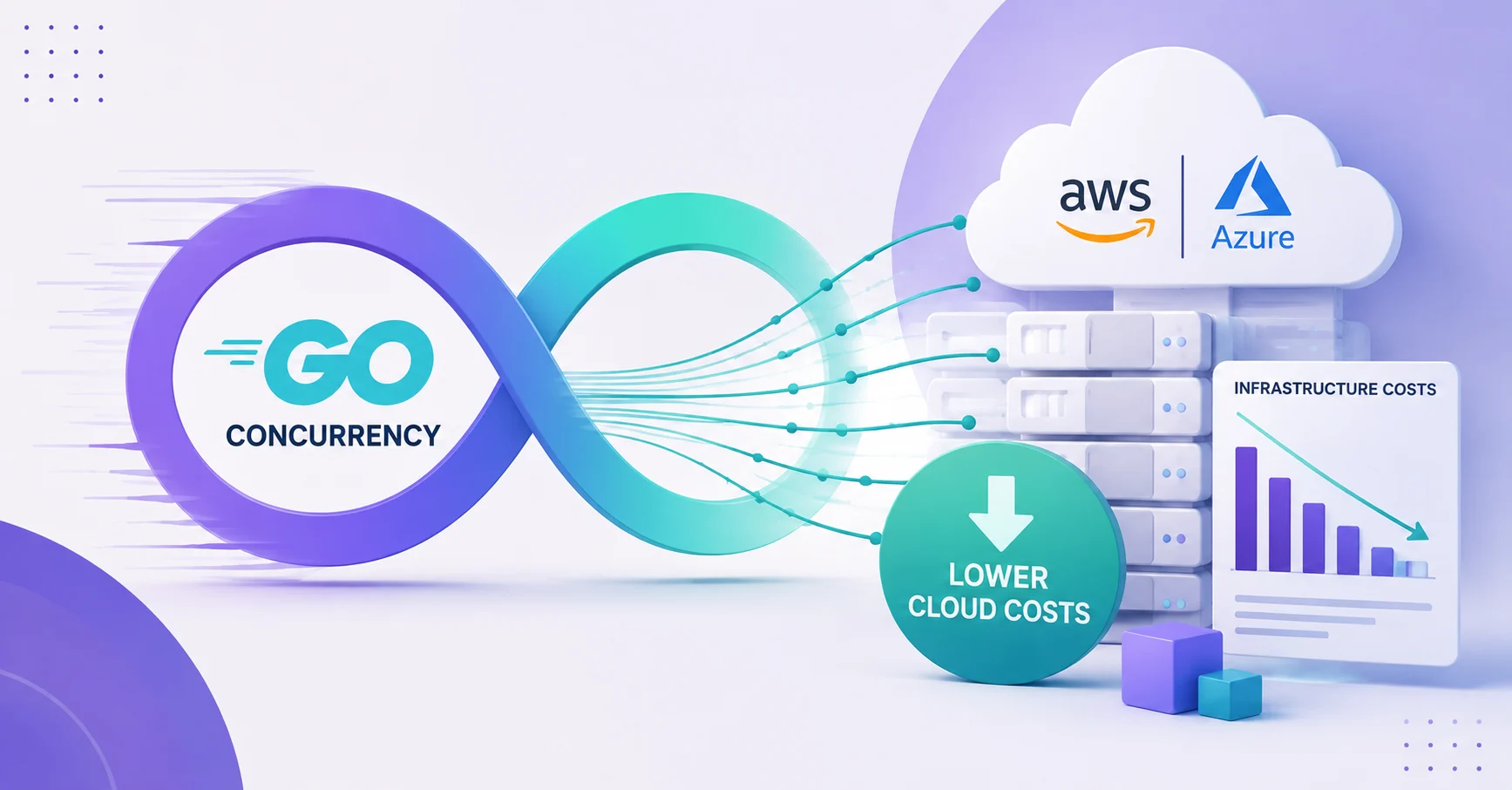
As cloud adoption matures, CTOs, IT managers, and enterprise leaders face a shared challenge: controlling rising infrastructure bills on Amazon Web Services (AWS) and Microsoft Azure. High compute allocations, over-provisioned virtual machines, and bloated memory footprints quickly erode profit margins. In many cases, these ballooning costs stem not from application usage, but from inefficient runtime architectures.
Achieving sustainable Golang cloud cost optimization empowers technical leaders to systematically lower resource overhead without degrading service quality. Modernizing backend architectures through targeted cloud infrastructure cost optimization practices ensures your organization pays only for the compute capacity it actually consumes.
Traditional enterprise backends built on platforms like Java, C#, or Python often require heavy system resources to handle concurrent traffic. When user demand spikes, cloud auto-scalers provision additional instances to compensate for runtime overhead, multiplying monthly hosting fees. Partnering with elite engineering teams providing Golang development services Princeton NJ organizations rely on allows businesses to refactor resource-heavy microservices into ultra-lean backend components.
Switching to Go (Golang) offers an architectural solution to this problem. Designed by Google specifically for multi-core processors and networked systems, Go uses a concurrency model that lowers CPU and memory consumption. By modernizing legacy services to Go, organizations can cut their AWS and Azure compute footprints without sacrificing performance.
The Hidden Cost of Concurrency in Legacy Runtimes
Understanding why cloud bills grow requires examining how traditional programming languages handle simultaneous user requests.
Thread-per-Request Bottlenecks
In traditional runtime models, handling concurrent HTTP or database requests often relies on operating system (OS) threads. An OS thread is a heavy resource, typically allocating 1 MB to 2 MB of stack memory at startup. When an application receives thousands of concurrent connections, memory usage escalates rapidly.
To prevent server crashes, cloud architects provision larger instance types, such as AWS EC2 m5.2xlarge or Azure Standard_D8s_v5. These instances cost hundreds or thousands of dollars per month per node. Much of that paid compute capacity goes toward managing thread overhead rather than executing core business logic.
Garbage Collection and Idle Memory Overhead
Interpreted or virtual-machine-based languages require continuous garbage collection (GC) cycles and runtime memory management. These background processes consume CPU cycles and create latency spikes, forcing systems to scale out early across cloud regions.
The Golang Concurrency Engine: Goroutines vs. OS Threads
Golang eliminates the reliance on heavy OS threads by introducing goroutines, which are managed directly by the Go runtime scheduler rather than the underlying operating system.
Operating System Thread Model (Java / C# / Python)
- Execution Flow: Incoming requests map directly to individual OS threads running inside a virtual machine or interpreter.
- Resource Cost: Each request consumes approximately 1 MB to 2 MB of stack memory baseline.
- Cost Impact: Causes rapid memory spikes and forces early scaling to high-RAM cloud servers.
Golang Runtime Scheduler Model (Goroutines)
- Execution Flow: Incoming requests are received by the lightweight Go runtime scheduler.
- Resource Cost: Goroutines begin with a tiny ~2 KB stack allocation and scale dynamically as needed.
- Cost Impact: Thousands of goroutines are multiplexed onto a single OS thread, maintaining low memory footprints and maximum CPU utilization.
Efficient CPU Multiplexing
The Go runtime uses an M:N scheduler, multiplexing $M$ goroutines onto $N$ OS-level threads. When a goroutine pauses to wait for a database query or network response, the Go scheduler switches execution to another goroutine on the same thread. This continuous CPU utilization keeps core usage high without triggering auto-scaling thresholds.
Direct Cost Reductions on AWS and Azure
Optimizing system resources with Go leads to immediate savings on monthly cloud invoices across AWS and Azure environments.
Downsizing AWS EC2 and ECS Tasks
Transitioning services to Go allows enterprise teams to migrate workloads from high-memory instances to cost-effective AWS Graviton (c7g or c6g) instances. Because Go compiles directly to native machine code, it takes full advantage of ARM64 architectures, reducing EC2 instance bills by up to 50 percent.
Maximizing Azure Kubernetes Service (AKS) Pod Density
In containerized Azure environments, memory limits determine how many container pods fit on a single node. High baseline memory forces DevOps teams to add more cluster nodes. Go’s small binary sizes and low RAM footprint allow teams to pack up to 4x more container pods onto each Azure VM node, shrinking the total cluster footprint.
Architectural Best Practices for Cost-Optimized Go Services
Writing Go code alone is not enough; implementing proper architectural patterns is key to maximizing cost efficiency.
- Utilize Worker Pool Patterns: Bound system resource consumption by capping the number of active goroutines processing background jobs, preventing unconstrained memory spikes.
- Pass Contexts for Early Cancellation: Propagate
context.Contextcancellation signals across HTTP and gRPC calls. When a user cancels a request, Go immediately frees up memory and CPU resources. - Leverage Channels for Synchronization: Use native Go channels to pass data between goroutines cleanly, avoiding costly lock contention and shared memory overhead.
- Keep Docker Images Minimal: Build Go applications into static binaries deployed on minimal Docker base images, such as
scratchoralpine. This reduces cloud container registry storage costs and speeds up container deployment times.
FAQs
How does Golang reduce cloud infrastructure costs compared to Java or C#?
Golang uses lightweight goroutines instead of heavy operating system threads, requiring significantly less RAM and CPU per connection. This efficiency allows applications to handle higher request volumes on smaller, lower-tier AWS EC2 or Azure VM instances.
Will migrating our legacy services to Go disrupt our existing AWS or Azure setup?
No. Go applications compile into standard, self-contained binaries that integrate seamlessly into existing AWS EKS, ECS, Azure AKS, or serverless infrastructure without requiring changes to your broader cloud architecture.
Does Golang concurrency work well with serverless models like AWS Lambda or Azure Functions?
Yes. Go’s fast startup times and minimal memory footprint make it ideal for serverless environments. Cold start delays are reduced to milliseconds, and function execution times are shorter, directly lowering serverless billing metrics.
What percentage of cloud cost savings can an enterprise expect after converting to Go?
While results depend on the specific application, organizations migrating high-concurrency APIs or background workers to Go routinely achieve compute and memory cost reductions ranging between 40% and 70%.
Is it difficult for our development team to learn Golang concurrency patterns?
Go was designed by Google with simplicity in mind. Developers familiar with Java, C#, or C++ typically learn Go’s syntax and core concurrency features within two to three weeks.
Maximize Cloud ROI with CAT Software Services Inc
High cloud infrastructure costs should not be an accepted cost of doing business. By modernizing legacy monolithic architectures into high-performance Go microservices, enterprise organizations can reclaim cloud budgets, improve application responsiveness, and scale operations efficiently.
At CAT Software Services Inc, our cloud and software engineering teams specialize in custom application development, backend refactoring, and cloud architecture optimization across AWS and Azure. We help businesses modernize outdated software systems, eliminate operational bottlenecks, and design cloud-native architectures tailored to their strategic goals.
Ready to cut your AWS and Azure hosting costs with high-performance Go architectures? Contact the engineering specialists providing top-tier Golang development services Princeton NJ businesses trust at CAT Software Services Inc to schedule a consultation.
