

The Dallas-Fort Worth (DFW) metroplex has long been recognized as a thriving corporate hub, home to major leaders in logistics, financial services, healthcare, and technology. Over the past decade, enterprise growth across North Texas relied heavily on standard operational efficiencies. Robotic Process Automation (RPA), static workflow scripts, and rule-based software helped companies streamline repetitive task execution.
However, standard enterprise automation has hit a ceiling. Fixed, rule-based systems break when unexpected variables arise, require constant maintenance, and cannot reason through complex decision-making processes. Forward-thinking organizations are turning to professional Agentic AI development Dallas solutions to bridge this operational gap.
In 2026, North Texas leaders are making a decisive architectural leap. They are shifting from simple, reactive automation to goal-oriented, autonomous AI workflow integration. By deploying specialized AI agents capable of planning, evaluating context, executing tasks across complex system architectures, and self-correcting along the way, North Texas businesses are scaling operations with unprecedented agility.
Understanding the Shift: From Static Automation to Agentic Reasoning
Traditional software automation operates strictly on fixed conditions: “If event X happens, execute action Y.” This model works well for straightforward data entry, scheduled database syncs, or basic transactional routing. Yet, modern enterprise operations rarely remain simple. A minor schema change, an unstructured vendor email, or an unexpected inventory discrepancy can easily stop a standard RPA pipeline in its tracks.
Agentic AI changes this dynamic fundamentally. Instead of following rigid procedural steps, autonomous AI agents operate on goals, context, and iterative planning.
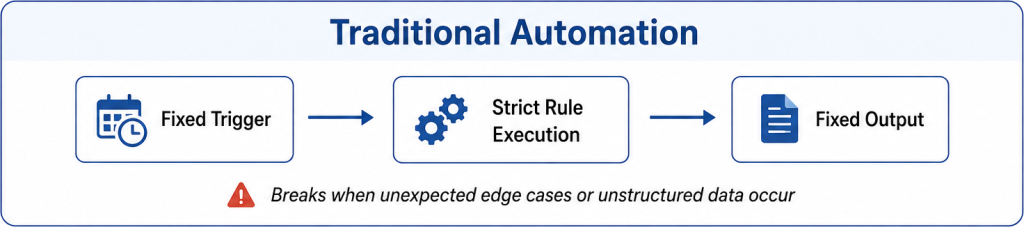
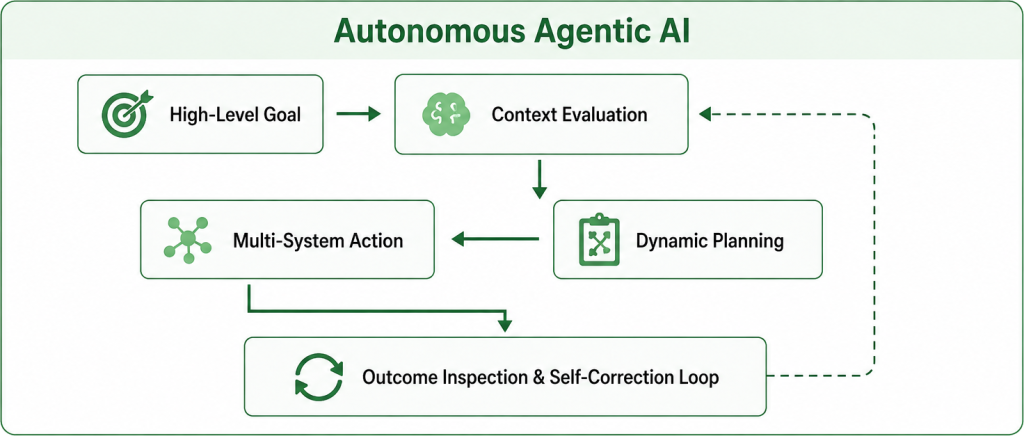
An agentic AI workflow evaluates high-level objectives, assesses incoming structured or unstructured information, dynamically determines the necessary intermediate steps, and interacts across multiple enterprise APIs to complete the job. If an edge case occurs, the agent does not instantly fail. It analyzes the error output, adjusts its operational strategy, and attempts a resolved path or routes a precise summary to a human manager for rapid oversight.
Core Pillars of Enterprise-Grade Autonomous AI Workflows
To deploy autonomous AI agents safely within enterprise environments, DFW technology leaders focus on four underlying foundational elements:
- Multi-Agent Coordination Architecture: Complex enterprise goals are rarely solved by a single large language model. Modern architectures deploy multi-agent frameworks where individual, specialized agents collaborate. For instance, an intake agent parses inbound customer inquiries, a validation agent verifies inventory across legacy systems, and an execution agent triggers fulfillment actions.
- Dynamic Tooling and API Integration: Autonomous agents are given secure access to enterprise toolsets, including REST APIs, SQL databases, ERP platforms (such as Microsoft Dynamics 365), and internal enterprise knowledge repositories. Agents construct queries, format payloads, and execute transactions safely within predefined permission boundaries.
- Contextual Memory and State Management: Effective agents maintain short-term working memory to execute multi-step tasks alongside long-term semantic memory stored in enterprise vector databases. This capability ensures continuity across long-running business processes.
- Human-in-the-Loop Safeguards: Autonomy does not mean operating without control. Leading organizations establish governance protocols that require explicit human approval for high-value financial actions, critical compliance checks, or low-confidence decisions.
How DFW Enterprise Sectors Are Leveraging Agentic AI in 2026
Enterprise adoption of agentic AI across North Texas spans critical regional industries, moving well beyond basic experimental chatbots to core operational workflows:
Supply Chain and Freight Logistics
DFW serves as one of North America’s premier logistics hubs. Local supply chain enterprises leverage multi-agent workflows to monitor real-time shipment delays, recalculate regional routing paths, adjust warehouse dispatch schedules, and autonomously communicate tailored status updates directly to enterprise clients.
Financial Services and Insurance
North Texas financial institutions employ autonomous workflow networks to accelerate loan processing, risk assessment, and claims processing. Rather than forcing human analysts to manually aggregate data across legacy databases, agents fetch credit records, evaluate supporting documentation against compliance guidelines, synthesize findings, and present comprehensive risk scores for swift human authorization.
Enterprise Healthcare Systems
Healthcare managers deploy AI agents to streamline patient intake workflows, verify complex insurance benefits across multiple payer networks, and handle back-office billing reconciliation, dramatically cutting down administrative overhead and billing errors.
Overcoming Key Implementation Challenges
Transitioning from simple script-based automation to multi-agent architectures requires careful strategy and robust engineering. Companies navigating this path often encounter three core implementation hurdles:
Governance, Security, and Compliance
Allowing AI agents to trigger actions across live enterprise systems introduces security considerations. Organizations must enforce strict Role-Based Access Control (RBAC), end-to-end telemetry logging, and ISO/IEC 27001-compliant security practices to ensure agents never exceed their authorized operational scopes.
Integration with Legacy System Architectures
Many established enterprises rely on legacy, custom-built, or on-premise platforms that lack modern REST APIs. Creating reliable integration layers, secure middleware, and wrapper services is essential for connecting modern agentic logic with existing enterprise infrastructure.
Hallucination Management and Deterministic Reliability
While generative models excel at reasoning, mission-critical business processes demand deterministic accuracy. Enterprises solve this by pairing non-deterministic agentic reasoning with strict validation logic, deterministic schema checks, and automated guardrails that intercept anomalous agent behaviors prior to database writes.
FAQs
What is the primary difference between traditional automation (RPA) and agentic AI?
Traditional automation follows rigid, predefined scripts to complete repetitive tasks and breaks when encountering unexpected changes. Agentic AI evaluates high-level goals, reasons through unstructured information, dynamically plans intermediate steps, and adapts to unexpected conditions to complete complex business workflows.
Are autonomous AI agents meant to replace human employees?
No. Autonomous agents are designed to handle complex administrative overhead, multi-system data gathering, and routine decision-making loops. This relieves human teams from tedious manual work, allowing staff to focus on strategic initiatives, high-value client relationships, and qualitative governance.
How do enterprises ensure AI agents do not make costly mistakes?
Enterprises implement strict security guardrails, human-in-the-loop workflows for high-risk actions, strict API permissions, and validation checks. Continuous telemetry and audit logging allow engineering teams to monitor agent decisions in real time.
How long does it typically take to deploy an agentic AI workflow into production?
Initial proof-of-concept deployments can take 4 to 8 weeks depending on integration complexity. Moving to a production-ready, enterprise-grade deployment with full compliance, legacy system integrations, and multi-agent coordination typically ranges from 3 to 6 months.
Can agentic AI integrate with custom legacy systems?
Yes. Modern enterprise AI development frameworks allow engineering teams to build custom API wrappers, secure database connectors, and middleware interfaces. This lets autonomous agents interact safely with legacy software platforms without requiring complete system overhauls.
Charting Your Path to Intelligent Enterprise Autonomy
As DFW enterprises continue driving business forward in 2026, competitive advantages will belong to organizations that build adaptable, self-correcting, and intelligent software systems. Transitioning to autonomous agentic AI workflows is no longer a distant theoretical shift; it is a practical engineering strategy yielding measurable operational efficiency.
Success in this landscape demands deep technical expertise in modern cloud architecture, system integration, robust QA standards, and specialized enterprise AI agent development Texas solutions.
At CAT Software Services Inc., we engineer bespoke, enterprise-grade software solutions tailored to your operational realities. Whether you are looking to modernize legacy IT architecture, build secure custom applications, or leverage specialized Agentic AI development Dallas solutions to automate your enterprise stack, our team delivers high-impact results with full transparency and rigor.
Ready to transform your enterprise workflows? Contact the experts at CAT Software Services Inc. today to schedule a discovery consultation and start building the future of your operations.
