
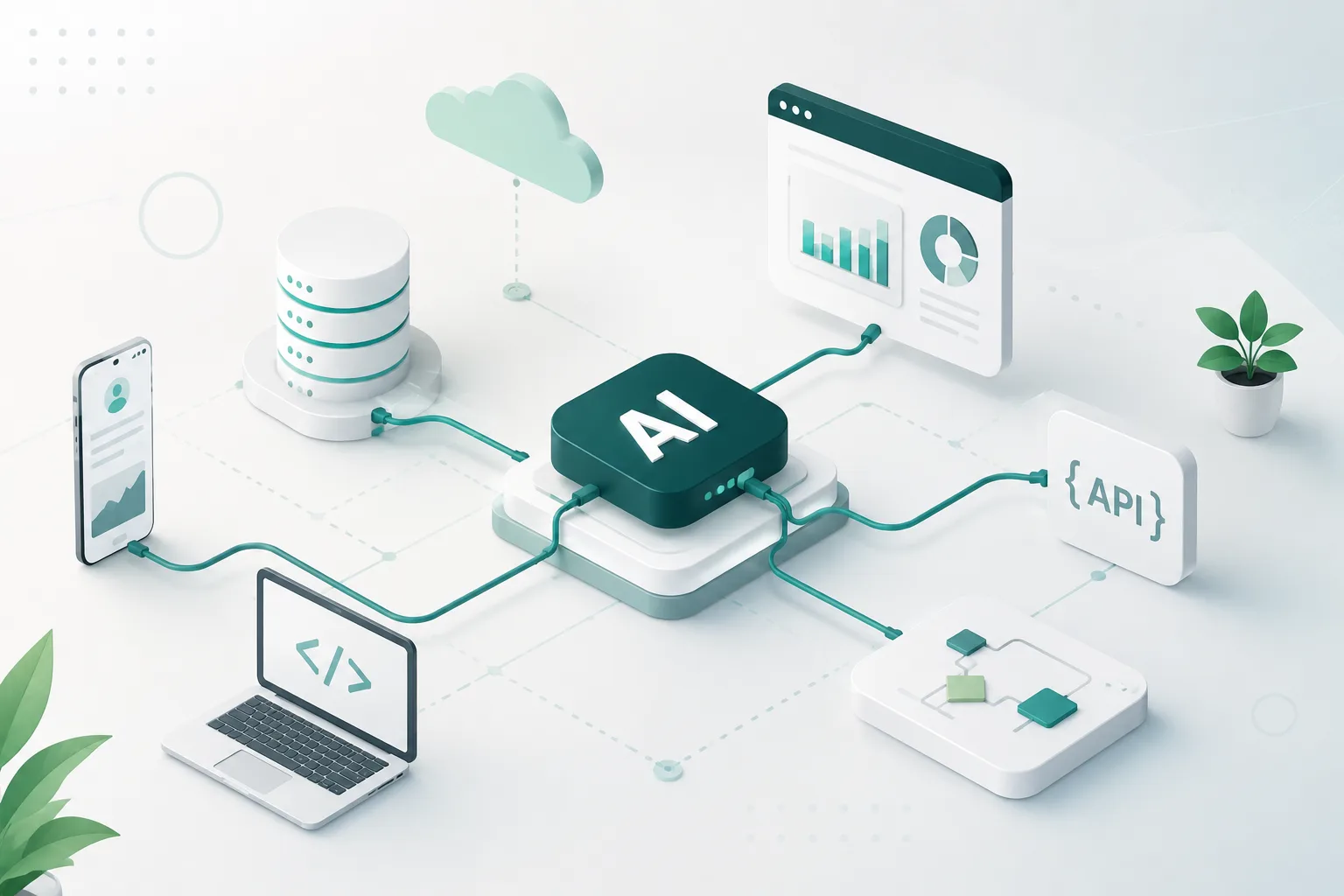
Across the expanding Dallas-Fort Worth technology sector, business leaders face a pivotal transition. The initial excitement around superficial artificial intelligence features, like basic customer service widgets and isolated content generators, is waning. Enterprise decision-makers recognize that standalone chatbots only address top-of-funnel interactions while leaving core operational friction untouched.
Partnering with top providers of full stack AI development services Dallas TX enterprises rely on gives local and national organizations the specialized engineering power needed to transform legacy workflows. Integrating tailored AI integration services Dallas TX leaders trust allows engineering leadership to systematically embed intelligence into every tier of their application ecosystem.
To achieve sustainable competitive advantage, Texas enterprises must move past surface-level tools and embed artificial intelligence directly into their application architecture through targeted custom AI development Dallas TX firms depend on. True digital transformation occurs when machine learning models, predictive analytics, and automated decision engines operate directly within core business logic.
Achieving this requires a cohesive approach to engineering. When frontend interfaces, secure backend APIs, and unified data pipelines work in unison, organizations turn complex operational data into real-time decision capabilities.
The Limitations of Surface-Level Chatbots
Many organizations began their artificial intelligence journeys by deploying off-the-shelf conversational bots. While these tools offer quick setup times and immediate visibility, they frequently operate as isolated silos disconnected from foundational business systems.
- Siloed Data Environments: Standalone chatbots rarely connect deeply with core ERP, CRM, or supply chain databases.
- Shallow Operational Impact: Answering routine customer FAQs does not automate internal workflows, manage inventory levels, or reduce financial risk.
- Accumulated Technical Debt: Adding multiple third-party tools on top of legacy architecture creates maintenance bottlenecks and security vulnerabilities.
Recognizing these boundaries, forward-thinking enterprises across North Texas are upgrading their engineering focus. They are transitioning from superficial add-ons to deep software refactoring that embeds intelligence directly into core business operations.
What Full-Stack AI Integration Means for Enterprise Systems
Full-stack integration embeds machine learning models and intelligent automation directly into every layer of software design. Rather than calling an external bot API as an afterthought, an integrated system incorporates data intelligence from user interaction down to database architecture.
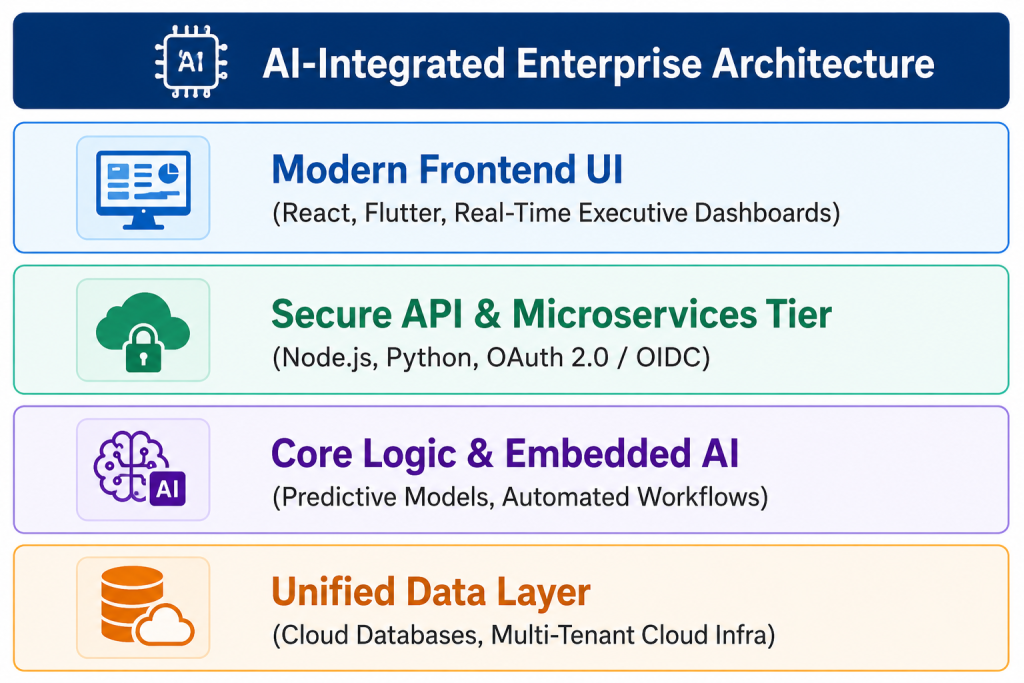
1. Resilient Full-Stack Foundations
High-performance platforms require resilient foundational architecture. Experienced engineering teams design cloud-native microservices and multi-tenant backends using tools like Node.js, Python, React, and Flutter. This approach guarantees that core systems handle heavy enterprise loads without performance degradation.
2. Embedded Core Logic and Automated Workflows
Instead of reliance on rigid rules or static forms, custom software platforms learn from incoming operational data. By inserting predictive models directly into business logic, software can automatically route approval tasks, trigger inventory reorders, flag anomalous transactions, and personalize user journeys in real time.
3. Unified and Secure Data Pipelines
Artificial intelligence models require reliable, clean data to deliver accurate outcomes. Full-stack engineering establishes structured data pipelines that securely capture user actions, transactional databases, and third-party inputs. Encrypting data at rest and in transit maintains compliance while fueling real-time analytics.
Operational Advantages for Dallas Tech Leaders and Enterprises
Partnering with an integrated software engineering team provides clear, measurable operational advantages for enterprises looking to scale efficiently.
- Accelerated Delivery Speed: Unified cross-functional teams eliminate handoff friction between isolated vendors, keeping software deployment schedules on track.
- Reduced Maintenance Overhead: Building a cohesive, cloud-native architecture prevents mismatched codebases, lowering long-term maintenance costs.
- Enterprise Scalability: Integrating data pipelines with microservices architecture maintains platform stability as transaction volumes grow.
- Measurable ROI: Software featuring built-in predictive tools and workflow automation delivers direct productivity gains across departments.
Protecting the Enterprise: Security in Modern AI Architectures
Expanding your technology stack to incorporate intelligent decision engines requires strong security measures. Exposing endpoints without strict oversight creates operational vulnerabilities. Enterprise systems must implement structured DevSecOps frameworks across every tier.
API Tier Defense
Protecting application interfaces with modern protocols like OAuth 2.0 and OpenID Connect guarantees verified access. Implementing rate limiting and dynamic throttling guards against system overloads and unauthorized data scraping.
Input Validation & Guardrails
Enforcing schema validation at the gateway level prevents malicious injections before payloads reach backend microservices. Dedicated input-output validation layers sanitize user inputs, preventing model exploitation and prompt injection risks.
Data Lineage and Governance
Enterprise architectures treat model outputs as untrusted data until validated, maintaining full traceability and continuous compliance across all decision channels.
Engineering Your Next Phase of Growth with CAT Software Services Inc
Executing deep system refactoring and embedding intelligence into enterprise software requires disciplined technical management and specialized execution capabilities. Attempting complex modernizations without proven engineering frameworks risks project delays and operational interruptions.
CAT Software Services Inc serves as a strategic technology partner for enterprise organizations seeking to build, scale, and modernize primary software assets. With a track record spanning over 500 delivered projects, our engineering teams bring technical expertise across cloud-native application development, API engineering, legacy system modernization, and secure AI integration.
CAT Software Services Inc delivers purposeful architectures aligned directly with your business goals, whether decoupling a legacy backend, building real-time analytics dashboards, or embedding predictive models into core workflows.
FAQs
What is the difference between custom AI integration and standard chatbots?
Standard chatbots act as conversational layers designed primarily for basic user interactions. Custom AI integration embeds machine learning algorithms directly into backend application logic, enabling automated workflows, predictive analytics, and real-time operational decisions across core business systems.
How does full-stack software refactoring improve legacy enterprise systems?
Full-stack refactoring systematically modernizes outdated applications by decoupling monolithic backends into agile cloud microservices, updating frontend interfaces, and refining database layers. This process reduces maintenance costs, closes security gaps, and improves release speed without disrupting daily operations.
Is full-stack AI integration safe for sensitive enterprise data?
Yes, when built using a security-first engineering methodology. Dedicated architectures enforce modern authentication protocols, encrypted data pipelines, role-based access controls, and input-output guardrails to protect confidential enterprise data.
How long does a typical custom enterprise software project take?
Project timelines vary based on system complexity, integration points, and overall scope. Proof-of-concept initiatives or targeted modernizations may launch in a few weeks, whereas enterprise applications typically evolve through structured, phased rollouts over several months.
Why should North Texas companies choose a specialized development partner like CAT Software Services Inc?
Partnering with CAT Software Services Inc offers direct access to experienced engineers who combine modern full-stack development with specialized AI and cloud capabilities. Our digital enablement model minimizes technical debt, speeds time-to-market, and delivers scalable platforms designed around your specific operational needs.
Unlocking Core Potential Through Intelligent Engineering
The gap between organizations utilizing surface-level digital tools and those running on intelligent, integrated logic is widening. Transitioning from simple conversational interfaces to deep full-stack AI integration allows Dallas enterprises to eliminate operational bottlenecks, strengthen data security, and scale efficiently.
Modernizing your software architecture protects existing investments while positioning your organization to capture new growth opportunities in an increasingly competitive market.
Partner with the regional experts in full stack AI development services Dallas TX firms rely on at CAT Software Services Inc. Reach out directly to our engineering team today to evaluate your technical architecture, address legacy technical debt, or begin building your next-generation software platform.
