
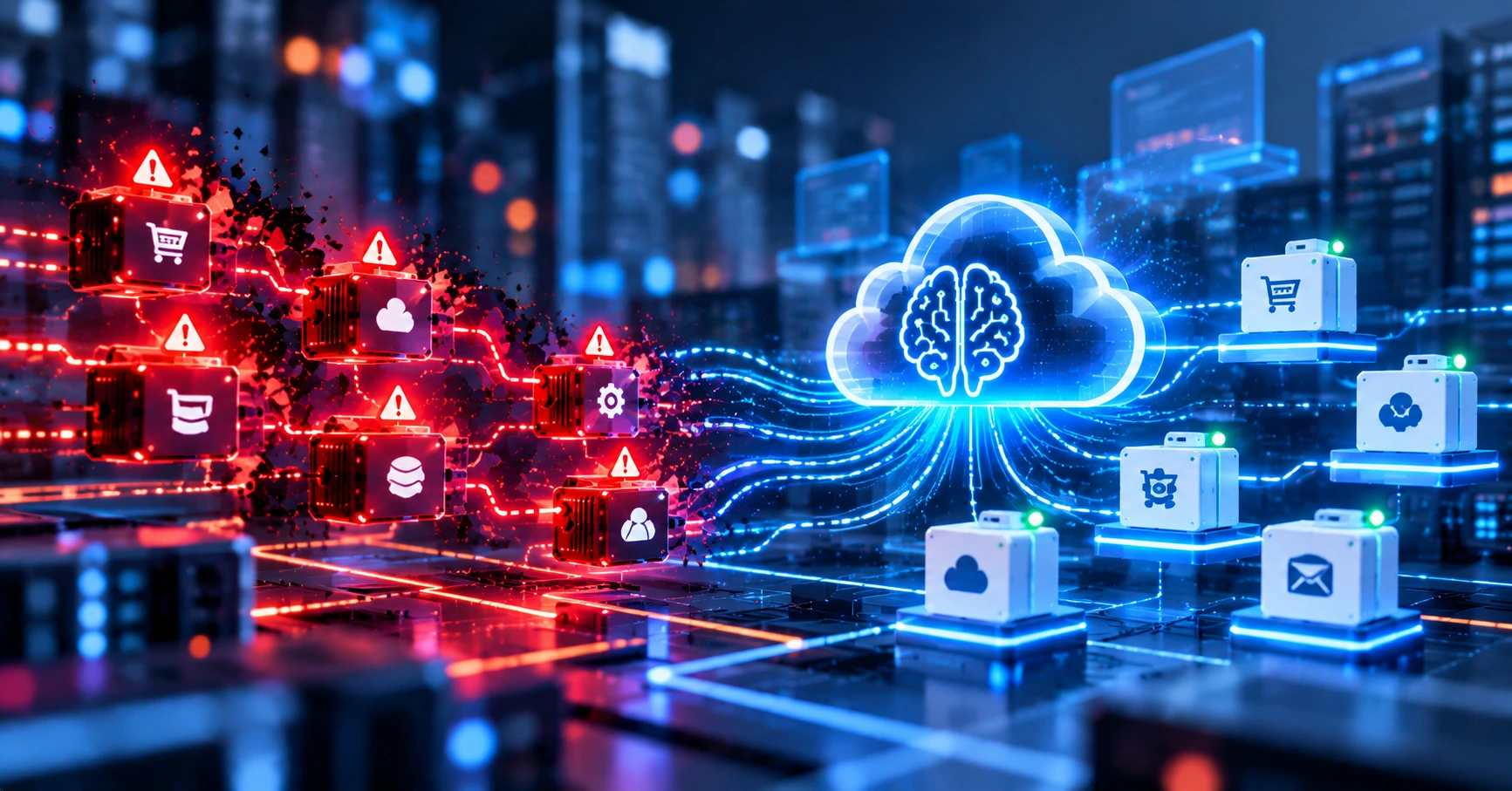
Modern enterprises rely heavily on microservices architecture to drive agility, scalability, and rapid feature deployment. Breaking a monolithic application into dozens of independent services allows engineering teams to innovate faster than ever before. However, this flexibility introduces a massive operational challenge. Managing distributed systems means managing distributed failure points. When a single service component experiences latency or crashes, it can trigger a cascading failure across the entire digital ecosystem.
Traditional IT support models are no longer sufficient to keep pace with these complex environments. Human monitoring teams cannot manually analyze millions of log lines or predict anomalies across dozens of interacting containers in real time. This operational gap exposes businesses to unexpected outages, lost revenue, and damaged customer trust. Integrating artificial intelligence into application support transforms how organizations handle system reliability. Companies partnering with CAT Software Services Inc can leverage cutting-edge AI and cloud solutions to secure their infrastructure and maintain high operational availability.
The Anatomy of Modern Microservices Complexity
Microservices decouple large applications into granular, independently deployable services that communicate via lightweight APIs. While this structure fosters development speed, it multiplies operational complexity exponentially. A single user request might traverse twenty different services before returning a response. If database connection pools stall in service number fifteen, diagnosing the root cause becomes a daunting diagnostic puzzle. Traditional reactive monitoring alerts engineering teams only after an outage has already impacted end users.
Furthermore, dynamic cloud environments scale up and down automatically based on traffic spikes. Infrastructure shifts constantly, making static threshold alerts completely obsolete. Teams find themselves drowning in false positives while genuine system vulnerabilities slip through unnoticed. This reactive cycle drains internal technical resources and distracts developers from building core product features. Modern architectures require intelligent oversight that evolves alongside the infrastructure itself.
The True Financial and Reputational Price of Outages
Downtime is rarely just a temporary inconvenience. For digital commerce platforms, financial institutions, and SaaS providers, even a few minutes of unavailability translates directly to lost revenue. Beyond immediate financial losses, prolonged outages erode brand credibility and customer loyalty. Users have high expectations for digital experiences, and they will quickly switch to a competitor if an application fails to load. Regain that lost trust requires months of remediation and public relations effort.
Hidden costs also include the toll taken on internal engineering teams. Waking up senior developers at midnight for firefighting duties leads to severe burnout and high employee turnover. Instead of driving strategic digital enablement, high-value engineering talent spends countless hours performing manual log analysis. Shifting toward intelligent application support protects both your bottom line and your internal workforce. Proactive oversight catches subtle system degradations before they escalate into full-scale production emergencies.
How Artificial Intelligence Redefines Application Support
Artificial intelligence changes application support from a reactive chore into a proactive science. Machine learning models ingest historical performance data to establish baselines for normal operational behavior. When anomalous patterns emerge, such as memory leaks or unusual traffic spikes, AI algorithms detect them instantly. These systems correlate disparate log events across multiple cloud providers to isolate root causes in seconds rather than hours. This capability drastically reduces Mean Time to Resolution.
Predictive analytics take this a step further by forecasting potential bottlenecks before they cause service disruptions. By anticipating capacity constraints or impending hardware failures, teams can schedule maintenance during off-peak windows. Intelligent automation can also execute self-healing protocols, such as restarting unresponsive containers or rerouting traffic dynamically. At CAT Software Services Inc, our experts specialize in embedding predictive analytics and automated workflows directly into custom-built enterprise solutions. This ensures your microservices remain resilient, secure, and fully optimized around the clock.
Key Benefits of Integrating AI Support Into Your Workflow
Adopting AI-driven support mechanisms delivers immediate, measurable value across your entire IT organization. Businesses experience a significant boost in operational productivity and system uptime.
- Proactive Issue Detection: Algorithms identify subtle performance degradations before users notice any friction.
- Accelerated Root Cause Analysis: Automated log correlation cuts down investigation time from hours to minutes.
- Resource Optimization: Smart monitoring prevents over-provisioning of cloud resources while maintaining high performance.
- Developer Empowerment: Freeing engineering teams from manual firefighting allows them to focus on core innovation.
These advantages directly support long-term growth and scalable digital transformation. When your applications run smoothly, your teams can focus on delivering exceptional value to your end customers.
FAQs
What makes microservices harder to support than monolithic applications?
Microservices consist of numerous independent services communicating over networks. A failure in one component can cascade across the system, and tracking transactions across distributed containers makes root cause analysis much more complex than in a single monolithic codebase.
How does AI improve traditional IT application support?
AI automates anomaly detection, correlates complex log data across distributed environments, and predicts potential system failures before they occur. This shifts support from a reactive firefighting model to a proactive, self-healing operation.
Can small and mid-sized businesses benefit from AI application support?
Yes. Scalable AI solutions and cloud management tools allow organizations of all sizes to automate monitoring and reduce downtime without needing massive internal IT operations teams.
What is the role of CAT Software Services Inc in cloud and AI solutions?
CAT Software Services Inc helps businesses design cloud-native architectures, implement machine learning models, and establish robust application support frameworks tailored to specific operational requirements.
How quickly can an AI-driven support framework be integrated?
Implementation timelines vary based on system complexity, but structured modernization approaches and proof-of-concept projects often deliver initial working prototypes and strategic assessments within a couple of months.
Securing Your Digital Future
Navigating the complexities of distributed microservices requires more than just reactive maintenance and basic monitoring tools. Embracing intelligent automation and predictive analytics ensures your applications remain dependable, secure, and ready for continuous growth. Protecting your infrastructure safeguards your revenue, your customers, and your valuable internal engineering talent.
If you are ready to eliminate costly downtime and elevate your application performance, connect with our experts today. Partner with CAT Software Services Inc to implement robust, tailored solutions that keep your business moving forward. Reach out to our team to schedule your consultation and discover how we can transform your IT operations.
