
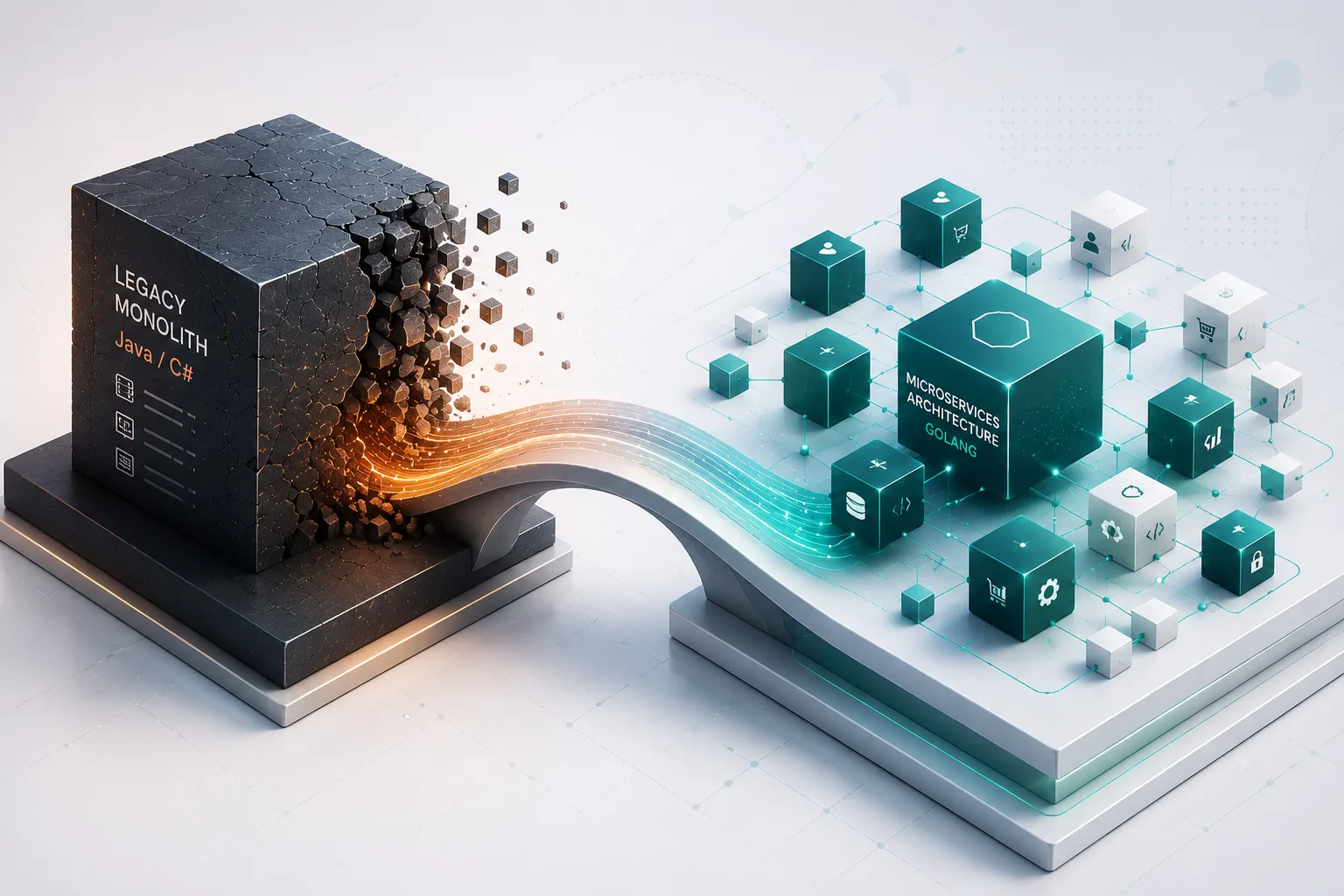
Enterprise applications built on Java or C# monoliths often reach a critical tipping point. Systems that once handled core business operations reliably begin to suffer from high cloud infrastructure costs, slow release cycles, and memory-heavy runtime footprints. As transactional volume grows across digital channels, scaling these heavy monolithic engines becomes economically inefficient and technically complex.
Partnering with top providers of Golang development services Princeton NJ enterprises trust provides local and national organizations with the specialized architectural expertise needed to modernize mission-critical systems. This approach enables engineering leadership to systematically decommission monolithic bottlenecks while maintaining uninterrupted live business operations.
Modernizing core backend systems to Go (Golang) has become a strategic imperative for forward-thinking engineering leadership. Go delivers exceptional native concurrency, minimal memory overhead, lightning-fast compilation, and compact binary deployments. These traits make Go an ideal programming language for cloud-native microservices environments.
However, tearing down a mission-critical system to rebuild it from scratch is rarely viable for established enterprises. A full system rewrite introduces severe business risk, prolonged release pauses, and potential revenue interruption. The true engineering achievement lies in executing a progressive migration from legacy Java or C# monoliths to Golang microservices with zero operational downtime.
Why Migrate from Java/C# to Golang?
Before mapping out the migration architecture, engineering teams must clarify the practical technical advantages driving the shift from classic object-oriented platforms to Go.
Resource Efficiency and Cost Optimization
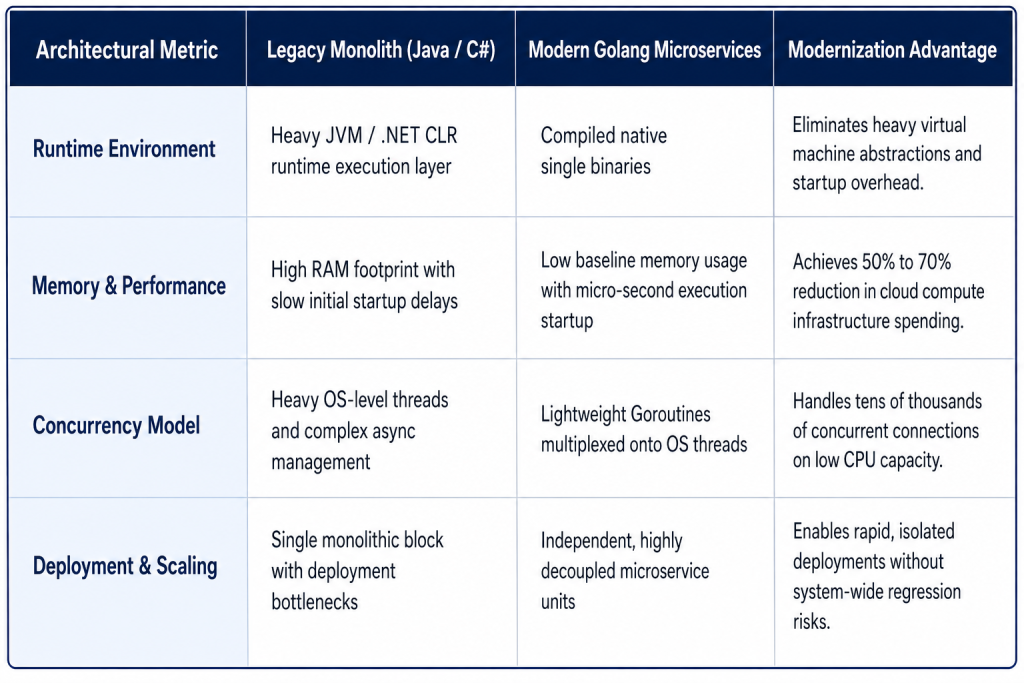
Java and C# runtimes require substantial baseline memory allocations for the Java Virtual Machine (JVM) or .NET Common Language Runtime (CLR). Periodic garbage collection pauses and heavy thread stack requirements often necessitate large, expensive compute instances. Go compiles directly to native machine code, running with a lean runtime footprint that sharply reduces ongoing cloud infrastructure costs.
Concurrency at Enterprise Scale
Handling high volumes of concurrent HTTP or gRPC requests in standard Java or C# architectures typically relies on thread-per-request models or OS-level threading, which consume notable system memory per thread. Go replaces this resource-intensive paradigm with goroutines, which are lightweight, user-space threads managed directly by the Go runtime. A single Go microservice can comfortably manage tens of thousands of simultaneous connections using a minimal memory allocation.
Operational Simplicity and Pipeline Speed
Go applications compile into static, self-contained single binaries containing all necessary dependencies. Containerizing Go applications yields extremely compact Docker images, accelerating CI/CD build times, streamlining deployment pipelines, reducing attack surfaces, and simplifying cloud orchestration.
The Zero-Downtime Migration Blueprint
Migrating live production infrastructure requires a methodical, incremental strategy. Replacing legacy business logic with modern Go microservices demands precise request routing, real-time data synchronization, and fail-safe fallback mechanisms.
1. The Strangler Fig Pattern
The Strangler Fig Pattern serves as the core architectural strategy for legacy system modernization. Instead of attempting a risky big-bang replacement, engineering teams incrementally extract bounded contexts into independent Go microservices.
An API Gateway is deployed in front of the application ecosystem. Initially, the gateway routes 100% of incoming production traffic directly to the legacy Java or C# application. As each new Go microservice is developed and validated, the API gateway configuration is updated to proxy specific endpoint routes (such as /api/v1/payments or /api/v1/inventory) away from the monolith to the corresponding Go microservice.
2. Database Decoupling & Dual-Writing
A primary challenge during microservice extraction involves shared database dependencies. Legacy monoliths often rely on deeply interconnected relational database schemas across multiple business domains.
To safely decouple database layers without data loss, organizations execute a three-phase data migration strategy:
- Dual-Writing: Update the data access layer so that new write operations write concurrently to both the legacy database and the newly created service-specific database.
- Backfilling: Replicate historical records into the new data store using automated background ETL pipelines.
- Dual-Verification: Run continuous background reconciliation scripts to verify data parity and integrity across both storage systems.
3. Traffic Shadowing (Dark Traffic Testing)
Deploying freshly written microservices directly to active end users carries operational risk. Traffic shadowing mitigates this by duplicating real production HTTP/gRPC requests at the API gateway level and forwarding a shadow copy to the new Go service in the background, without returning its response to the client.
This technique allows platform teams to analyze real-world memory profiles, evaluate garbage collection patterns, verify performance under genuine production loads, and uncover edge-case errors without impacting live user sessions.
4. Progressive Canary Releases
When cutting over production traffic, changes should be rolled out gradually using Canary Releases backed by automated metric monitoring:
- Phase 1: Route 1% of live traffic to the new Go microservice while maintaining 99% on the legacy application.
- Phase 2: Closely monitor latency thresholds, error response codes, and system throughput via telemetry tools.
- Phase 3: Incrementally adjust traffic splits (5%, 25%, 50%, 100%) over structured evaluation windows.
If metric anomalies or unexpected errors emerge at any point during rollout, dynamic feature flags allow instantly shifting traffic back to the legacy system without downtime.
Managing Architectural Shifts: Java/C# to Golang
Transitioning engineering teams from traditional object-oriented platforms (Java and .NET) to Go requires adapting to foundational structural differences:
- Composition Over Inheritance: Go intentionally omits class-based inheritance hierarchies. Developers utilize struct embedding and explicit interface implementation to design modular, flexible software components.
- Explicit Error Handling: Go replaces runtime exception throwing (such as try-catch blocks) with explicit error return values. This design encourages software engineers to handle error conditions deliberately at the exact call site where they occur.
- Implicit Interfaces: In Java and C#, classes explicitly implement declared interfaces. In Go, interfaces are satisfied implicitly whenever a struct implements the required methods, facilitating cleaner package separation and simplified unit testing with mocks.
FAQs
How long does a typical monolith-to-microservices migration take?
Migration timelines depend on domain complexity, system dependencies, and testing coverage. Incremental strangulation allows enterprise teams to deliver high-value extracted services to production within 3 to 6 months, rather than waiting years for a full system rewrite.
Will our engineering team need extensive retraining to adopt Go?
Go was designed specifically for engineering clarity and rapid adoption. Developers coming from C# or Java typically master core Go syntax within two weeks and become fully productive within a month, thanks to the language’s minimal keyword set and straightforward design.
How do we ensure data consistency between legacy and Go databases during migration?
Data consistency is maintained using dual-writing patterns coupled with asynchronous event streams (such as Kafka or RabbitMQ) and reconciliation scripts. System reads only transition to the Go service once verification scripts report a 100% data match across systems.
Is Golang suitable for all enterprise software domains?
Golang excels at high-throughput web services, API gateways, microservices, networking tools, distributed systems, and cloud-native applications. For deeply specialized enterprise scenarios requiring legacy desktop UI integration or complex ORM heavy ecosystems, selected hybrid integrations with C# or Java may remain beneficial.
How do microservices communicate efficiently during the interim migration phase?
During the transition phase, the legacy monolith and new Go microservices communicate using RESTful APIs, high-performance gRPC channels, or message queues like NATS, RabbitMQ, or Apache Kafka.
Accelerate Your Modernization Journey with CAT Software Services Inc
Transitioning from heavy Java or C# monoliths to ultra-efficient Go microservices is one of the most impactful investments an enterprise can make to reduce cloud overhead, eliminate technical debt, and accelerate feature delivery. Achieving this transformation without disrupting production operations requires seasoned architectural strategy and precise technical execution.
At CAT Software Services Inc, our experienced engineering teams specialize in custom software development, system architecture modernization, and cloud-native transformations. Whether you need senior technical consultants to architect your migration path or a full-stack development team offering comprehensive Legacy Code Migration services Princeton, we deliver secure, resilient, and business-focused software solutions.
Ready to modernize your legacy platforms with zero operational downtime? Partner with the industry leaders in Golang development services Princeton NJ organizations trust at CAT Software Services Inc. Explore our expertise and schedule a consultation today with our engineering specialists.
