
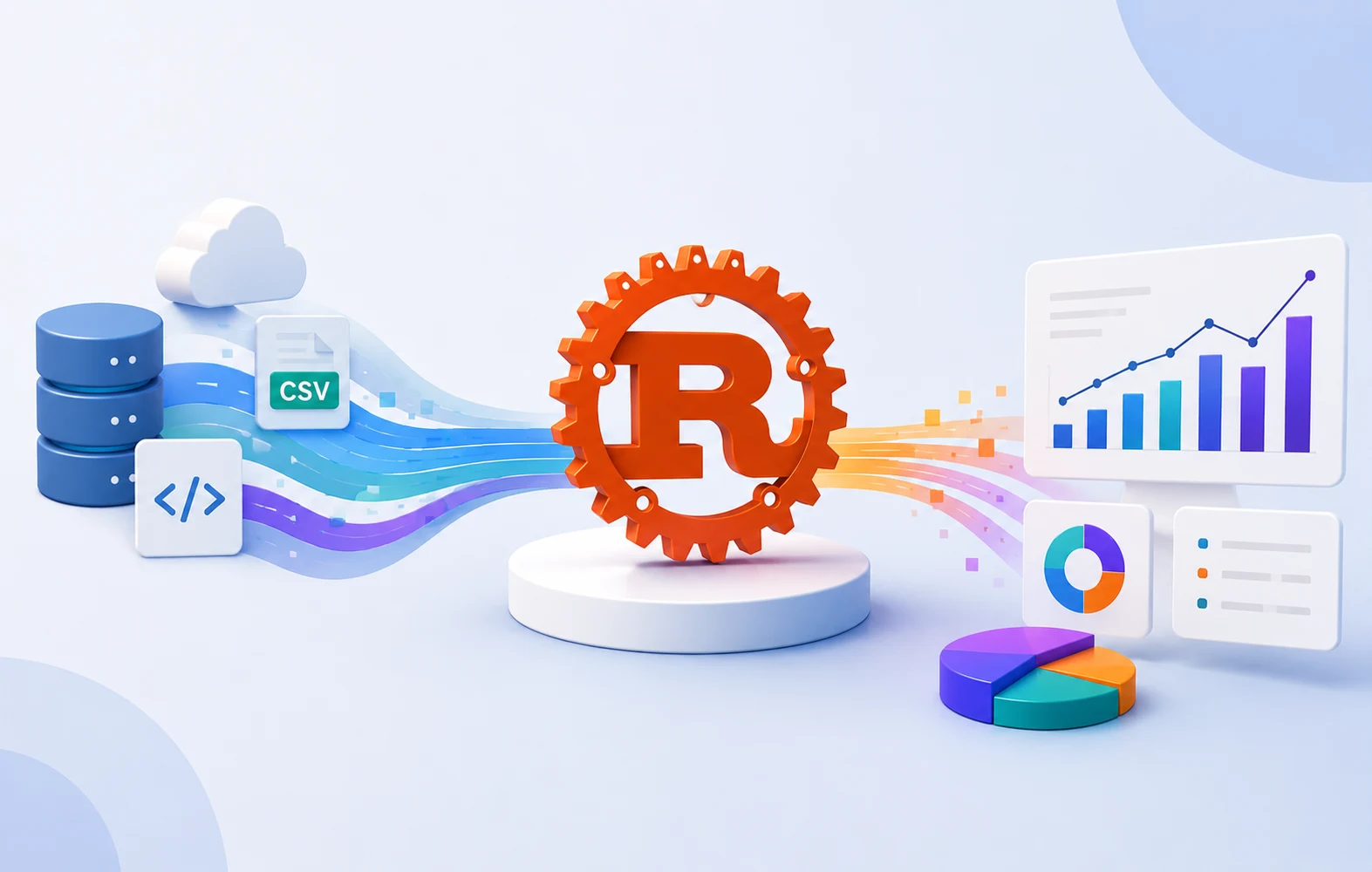
Enterprise data processing infrastructure across Austin, Round Rock, and San Marcos faces growing pressure under real-time analytics demands, growing cloud bills, and memory management overhead. To maintain computational efficiency, engineering teams are migrating high-throughput pipeline components away from traditional interpreted languages. Rust provides bare-metal execution speeds paired with compile-time memory guarantees, allowing organizations to process large datasets without overprovisioning servers.
Adopting specialized Rust software development Princeton NJ methodologies allows technical leaders to eliminate execution bottlenecks and secure low-latency analytics performance. By upgrading compute-heavy workloads, organizations achieve predictable execution without sacrificing system stability.
Leveraging dedicated Rust data processing development frameworks transforms heavy analytical jobs into lean, cloud-native workflows. Partnering with teams providing elite Rust development services Princeton NJ enterprises trust ensures your data pipelines handle massive throughput while dramatically lowering monthly cloud infrastructure spend.
The Modern Analytics Bottleneck in Enterprise Infrastructure
Enterprise data pipelines historically relied on Python, Java, and Scala. Python allows fast prototyping and holds a broad ecosystem of data libraries. Java and Scala formed the base for big data tools like Apache Hadoop and Apache Spark.
As datasets expand into terabytes and petabytes, these classic runtimes reveal hardware inefficiencies:
- Garbage Collection Pauses: Java-based processing frameworks trigger unpredictable garbage collection cycles that create latency spikes during real-time streaming.
- High Memory Overhead: Interpreted environments require heavy RAM footprints just to execute runtime environments, raising compute node expenses.
- Single-Thread Limits: Python relies on runtime thread locks that restrict true parallel execution, requiring complex multiprocess architectures that consume extra system memory.
Waiting minutes for batch queries or paying for redundant cloud compute nodes creates unnecessary operational drag.
Why Rust Is Transforming Enterprise Data Architectures
Rust combines speed, safety, and parallel processing capabilities to address hardware-level bottlenecks.
1. Bare-Metal Performance Without Garbage Collection
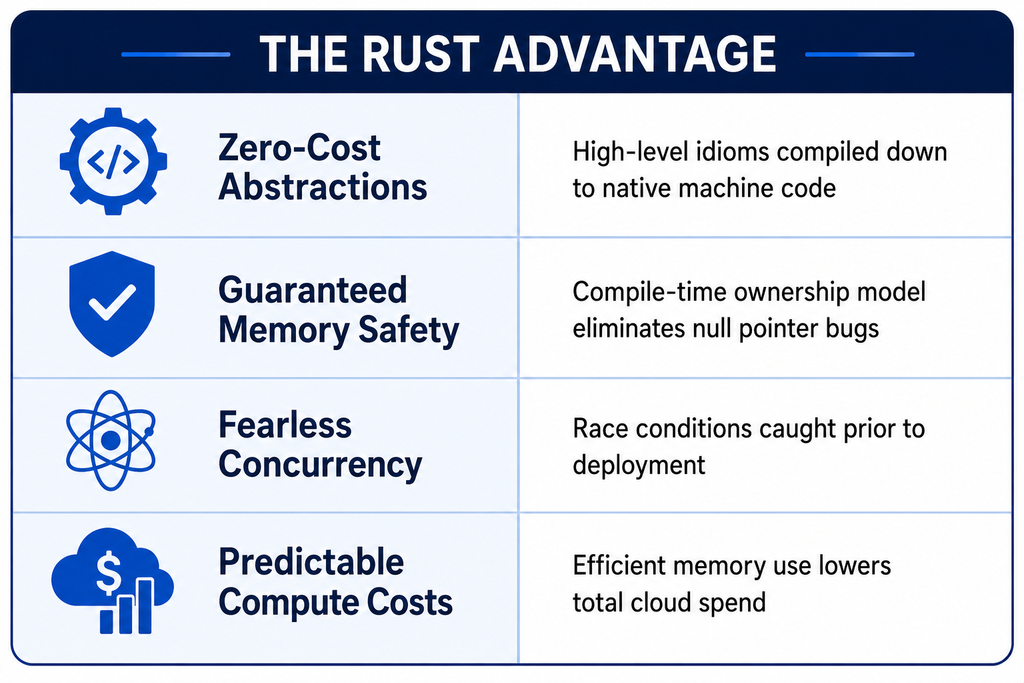
Rust compiles directly to machine code without a virtual machine or garbage collector. Execution timing remains predictable down to the microsecond. The compiler enforces strict ownership rules, freeing memory instantly when variables pass out of scope. This design maintains steady, low-latency performance across heavy analytical pipelines.
2. Concurrency for Parallel Data Pipelines
Modern server hardware requires multi-core utilization to process high throughput. Writing multi-threaded C or C++ risks memory leaks, data races, and pointer crashes. Rust catches invalid concurrent data access during compilation. Code that compiles successfully in Rust runs without data races across parallel threads.
3. Native Integration with Apache Arrow and Polars
Modern data engines rely directly on Rust. The Apache Arrow project uses an in-memory columnar format designed for modern hardware, with its Rust implementation ranking among the fastest available. Rust also powers query engines like Polars and DataFusion, giving teams SQL and DataFrame interfaces that process datasets faster than traditional libraries.
Measurable Outcomes for Central Texas Enterprises
Upgrading core analytics systems to Rust yields direct financial and operational results for technical leadership.
Reductions in Cloud Infrastructure Spend
Cloud compute is a major operational expense. Legacy data engines scale horizontally across dozens of cloud instances to overcome execution bottlenecks. Because Rust uses CPU cores and RAM efficiently, engineering teams’ aggregate large workloads onto fewer nodes, lowering cloud computing bills by 40% to 70%.
System Reliability and Data Accuracy
Silent runtime crashes inside an analytics pipeline corrupt downstream business reports. Rust eliminates pointer bugs, dangling references, and buffer overflows at compile time. Compiler-level verification keeps production systems running without manual operational fixes.
Practical Deployment Strategies for Engineering Teams
Migrating an enterprise platform to Rust does not require an immediate, full-system rebuild. An incremental approach reduces risk while improving processing speeds early:
- Identify High-Cost Bottlenecks: Profile the current pipeline to locate specific services causing latency spikes or consuming high cloud memory.
- Build Rust Microservices: Replace high-traffic endpoints or compute-heavy transformation modules with standalone Rust microservices.
- Expose C-Compatible APIs: Connect Rust libraries to existing Python or Node.js services using foreign function interfaces like PyO3.
- Standardize on Columnar Formats: Implement Apache Arrow for memory transport between services to eliminate data conversion overhead.
FAQs
Is Rust difficult for existing enterprise teams to learn?
Rust requires time to learn its ownership and borrowing rules. Developers with C++, Java, or TypeScript backgrounds build proficiency within a few weeks. The compiler supplies clear error messages that help developer’s correct memory usage during development.
Can Rust integrate with existing Python data science tools?
Yes. Tools like PyO3 allow developers to write compute-heavy logic in Rust and call it directly inside Python scripts. Data scientists keep their standard Python scripts while using Rust execution speed under the hood.
How does Rust lower cloud computing expenses?
Rust runs without virtual machines or garbage collectors. By running natively on CPU hardware and managing RAM tightly, application microservices handle greater throughput on smaller server instances.
Is Rust ready for production enterprise data pipelines?
Yes. Companies like AWS, Cloudflare, Microsoft, and Meta run Rust inside production environments. The data engine ecosystem around Apache Arrow, DataFusion, and Polars is stable and widely deployed.
Should an engineering team rewrite an entire analytics platform in Rust at once?
Rewriting an entire platform at once carries unnecessary operational risk. Modernize targeted components by isolating high-latency nodes or memory-intensive services, rewriting those specific modules in Rust, and integrating them back into the pipeline.
Building High-Throughput Analytics Platforms
As data throughput scales across Central Texas, maintaining low operational costs requires efficient software architecture. Moving data processing components to Rust enables systems to process larger workloads faster on lower hardware footprints.
Partner with the experienced leaders in Rust software development Princeton NJ at CAT Software Services Inc. to assess processing bottlenecks, design high-throughput data platforms, and execute microservice migrations. Schedule a discovery call with technical experts at CAT Software Services Inc. to start analyzing system pipelines.
