
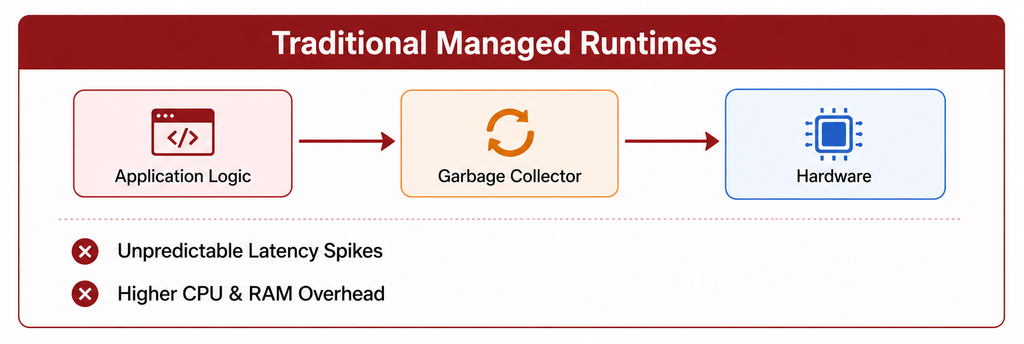
Enterprise backend architecture in financial and technology centers like New York City and Princeton, New Jersey, faces heavy performance demands. Modern organizations process millions of concurrent requests, manage complex cloud infrastructure, and maintain data security protocols. Traditional runtimes often struggle under this load, leading to high server costs, memory leaks, and unpredictable latency spikes from garbage collection pauses.
To maintain performance, technical leaders refactor memory-bound microservices using Rust. Known for zero-cost abstractions and compile-time memory guarantees, Rust has transitioned from a systems language into a practical foundation for enterprise backend infrastructure. Implementing specialized Rust backend development Princeton NJ strategies empowers organizations to achieve unmatched execution speed, stability, and data protection.
By leveraging dedicated Enterprise Rust API development methodologies, organizations can fortify critical software systems against runtime vulnerabilities. Partnering with experienced engineering teams providing Rust development services Princeton NJ businesses rely on ensures your digital platforms scale effortlessly while lowering cloud infrastructure spend.
Why Modern Enterprises Are Transitioning to Rust for API Infrastructure
For years, languages like Java, Python, Node.js, and Go dominated web API development. While these environments offer quick initial setups, they present distinct operational trade-offs at enterprise scale. Interpreted languages often encounter CPU bottlenecks, while garbage-collected runtimes introduce random latency jitter during memory cleanup cycles.
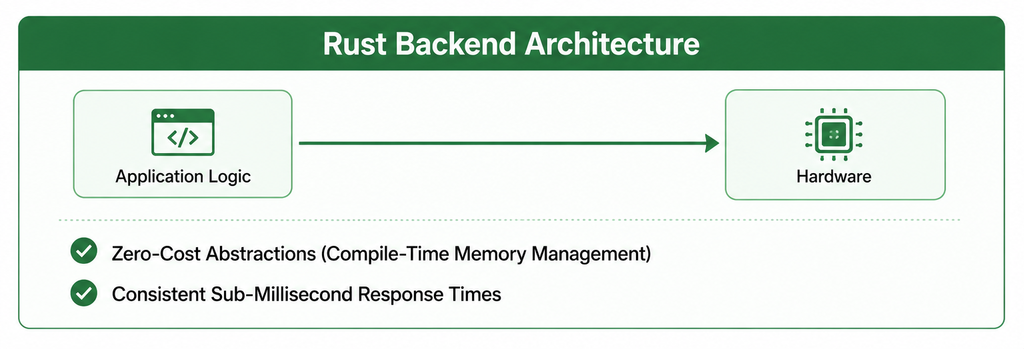
Rust eliminates this trade-off by combining C-like hardware speed with mathematical guarantees of memory safety.
Eliminating Runtime Memory Vulnerabilities
Memory corruption bugs, such as buffer overflows, use-after-free errors, and double frees, account for a large portion of enterprise security flaws. Rust solves this problem at the language level through its compile-time ownership and borrowing model. By catching memory errors during compilation rather than in production, Rust helps web APIs stay resilient against common exploit vectors without a heavy runtime manager.
Sub-Millisecond Execution Speeds
In high-frequency trading platforms in Manhattan or data systems in Princeton, execution speed matters. Rust compiles directly to native machine code without an interpretation layer. APIs built in Rust deliver low response times and sub-millisecond throughput under concurrent traffic.
Infrastructure Cost Reductions
Garbage-collected backend runtimes require extra RAM and CPU headroom to cushion memory cleanup cycles. Because Rust manages memory deterministically at compile time, APIs consume a small fraction of the memory footprint required by traditional frameworks. Replacing heavy microservices with lean Rust services allows enterprises to scale back cloud instance counts on AWS, Azure, or Google Cloud Platform, directly lowering cloud spending.
Core Pillars of Enterprise Rust API Architecture
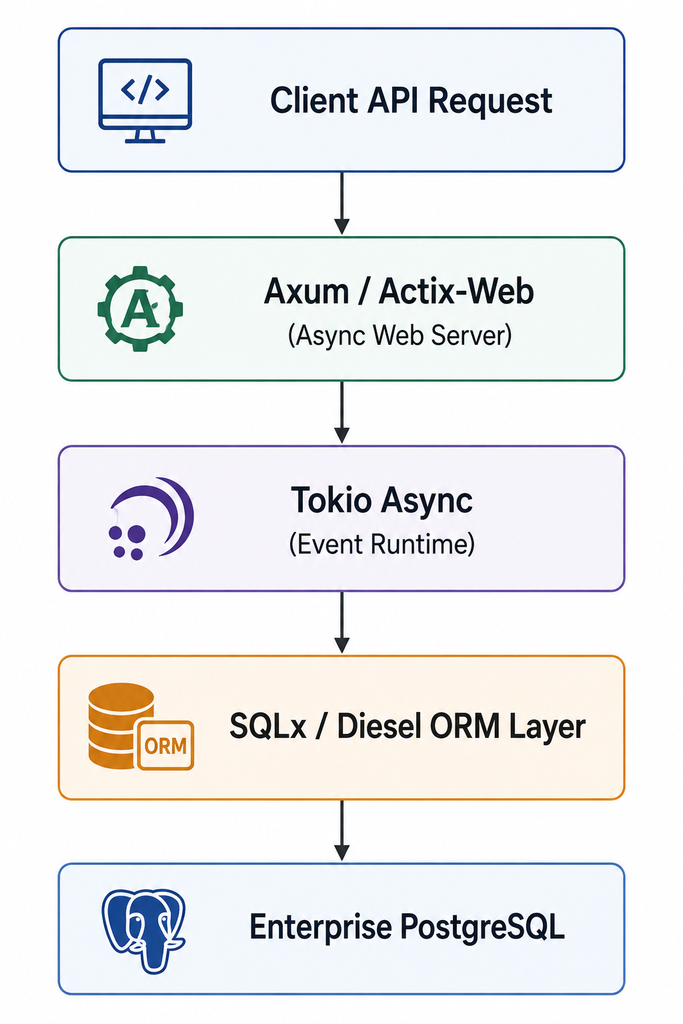
Building production-ready Rust APIs involves selecting an ecosystem of libraries built for high-concurrency enterprise workloads.
1. Asynchronous I/O with Tokio
The foundation of modern Rust backends relies on Tokio, an asynchronous, event-driven runtime built for non-blocking I/O. Tokio enables a single Rust backend service to handle tens of thousands of simultaneous connections using minimal thread counts.
2. Enterprise Frameworks: Axum and Actix-Web
For routing, request handling, and middleware integration, development teams utilize Axum or Actix-Web:
- Axum: Maintained by the Tokio team, Axum offers direct integration with the Tower ecosystem of modular middleware, providing clean developer ergonomics and strong type safety.
- Actix-Web: Known as a fast web framework, Actix-Web provides high throughput and stability for performance-focused REST and WebSocket endpoints.
3. Compile-Time Safe Database Access
Integrating databases with enterprise APIs traditionally introduces runtime SQL query risks. Rust tools like SQLx validate raw SQL queries against a live database during compile time. This practice confirms that schema mismatches, typos, and invalid type conversions are caught before code reaches staging environments.
Practical Use Cases for Rust APIs in New York & Princeton
Businesses throughout the Princeton and NYC technology ecosystem rely on custom software engineering to maintain operational stability. Modern Enterprise Rust API development provides practical results in several application domains:
- Financial Technology & High-Frequency Services: Real-time payment processing, algorithmic trading engines, and risk systems in Wall Street and Midtown NYC benefit from predictable execution times without latency delays.
- Healthcare & Life Sciences Platforms: Organizations near the Princeton biotech corridor handle large volumes of sensitive patient data. Rust provides strict security guarantees and fast data processing while aiding compliance with data safety regulations.
- Legacy Modernization & Microservices Refactoring: Many enterprises operate monolithic legacy backends that have become slow to scale. Refactoring bottleneck endpoints into lightweight Rust microservices improves platform speed without requiring a complete rewrite of existing systems.
- Real-Time Data Streaming & IoT Gateways: For platforms aggregating sensor data, analytics, or continuous user telemetry, Rust APIs parse and forward high-volume data streams without exhausting host server memory.
Working with CAT Software Services Inc. for Rust API Development
Integrating Rust into an enterprise stack requires clear architectural design. While Rust delivers high runtime performance, its strict compiler rules demand experienced software engineers who build clean, maintainable systems from day one.
CAT Software Services Inc. assists established businesses with scaling digital capabilities through software engineering, cloud architecture, and system modernization.
Regional Enterprise Integration with CAT Software Services
- End-to-End System Architecture: We design scalable microservices and REST/gRPC APIs built around your enterprise business logic, data models, and integration constraints.
- Senior Engineering Talent: Our engineering teams build high-performance backends, ensuring your codebase adheres to clean architecture principles and strict security standards.
- Direct Stack Integration: We connect new Rust services directly into your existing setup, including standard integrations with SAP, Salesforce, custom ERPs, and primary cloud providers (AWS, Azure, and GCP).
- Agile & Secure Delivery: Operating with structured security standards, ISO/IEC 27001 alignment, and clear communication workflows, we provide transparency across every iteration.
CAT Software Services Inc. provides technical execution to replace performance-limited microservices, secure high-volume financial endpoints, or construct cloud backends on schedule.
FAQs About Rust API Development
Is Rust mature enough for enterprise web API development?
Yes, Rust is fully enterprise-ready. Industry leaders such as Microsoft, Amazon, Google, and Meta rely on Rust for core infrastructure services. Production-proven frameworks like Tokio, Axum, and SQLx provide stable, long-term support for enterprise web API development.
How does Rust compare to Go for backend microservices?
While Go offers simple syntax and fast initial development, it relies on a garbage collector that can introduce occasional latency spikes under heavy load. Rust provides predictable performance without garbage collection pauses, lower memory usage, and stronger compile-time safety guarantees for high-concurrency systems.
Can Rust APIs integrate with existing Java, Python, or .NET microservices?
Yes. Rust APIs communicate over standard protocols such as HTTP/REST, gRPC, WebSockets, and GraphQL. This flexibility allows a Rust service to sit inside any multi-language microservices architecture, replacing specific performance bottlenecks while communicating directly with existing applications.
How does building APIs in Rust help lower AWS or Azure infrastructure costs?
Because Rust manages memory deterministically without runtime overhead, Rust services consume less RAM and CPU than equivalent Node, Java, or Python applications. This reduced resource consumption allows businesses to run workloads on smaller cloud instances, directly cutting monthly infrastructure costs.
How long does it take to refactor a legacy backend endpoint to Rust?
Project timelines vary based on business logic complexity, database dependencies, and test coverage needs. Typically, initial discovery and architecture planning take one to two weeks, followed by iterative development sprints. CAT Software Services Inc. works directly with your internal teams to provide clear timelines and incremental rollouts.
Technical Execution for Enterprise Backend Modernization
Adopting Rust for core API services resolves systemic performance bottlenecks, lowers monthly cloud infrastructure spend, and eliminates runtime memory vulnerabilities. For organizations managing high-concurrency workloads across New York City and Princeton, Rust provides a stable long-term architecture for backend services.
Contact the technical engineering team at Rust backend development Princeton NJ leaders at CAT Software Services Inc. to schedule a backend architecture review and evaluate your API migration path.
